Rudolf Diesel was one of the most celebrated inventors on earth when he stepped aboard a steamship in Antwerp, Belgium, in 1913. He dined in the ship’s restaurant, asked to be awakened at 6:15 the next morning, and retired to his cabin. His bed was never slept in. His nightclothes lay untouched on the mattress. His hat and coat were found folded neatly on the deck railing. When the SS Dresden docked at Harwich, England, the following morning, Diesel had vanished. Ten days later, a Belgian sailor spotted a body floating in the English Channel. The man who invented the engine that would eventually move roughly 70 percent of all freight in America disappeared on the eve of a world war, and more than a century later, no one knows exactly what happened to him. What nobody understood at the time was that Diesel’s death was only the beginning of the story. The engine he left behind was about to reshape transportation, warfare, and an entire American commercial sector that still runs the country today. But that story does not begin on a steamship in the English Channel. It begins in a workshop in southern Germany, with a ten-foot iron cylinder and a man who kept blowing things up.

Rudolf Diesel was born in Paris in 1858 to German parents. By the time he was fourteen, he was already writing to his parents to tell them he wanted to become an engineer. That was no passing ambition. Diesel won a merit scholarship to the Royal Bavarian Polytechnic Institute in Munich, one of Europe’s finest engineering schools, where one of his professors, Carl von Linde, put him to work at an ice and refrigeration plant. Within a year, Diesel was running the place. He stayed on to manage the company’s research, and there, amid compressors and cooling systems, he began to think seriously about thermal efficiency. The steam engines that powered factories and trains across late nineteenth-century Europe were, to put it politely, bad at their jobs. They converted only about 10 percent of the energy they consumed into actual work. The other 90 percent was wasted heat dissipating into the air, while factory owners kept shoveling more coal into the furnaces. Diesel spent years obsessing over thermodynamics, filling notebooks with diagrams and running calculations on heat transfer and compression ratios, convinced there had to be a better way to turn fuel into motion. In 1892, he filed a patent for a new kind of engine — not a gasoline engine, which uses a spark plug to ignite fuel. His design worked on an entirely different principle. You compress air inside a cylinder until it becomes extremely hot, several hundred degrees. Then you inject fuel directly into that superheated air, and it ignites on its own. No spark plug needed. No external ignition at all, just physics. In theory, his engine could reach 50 percent efficiency. That was five times better than steam engines. The following year, Diesel published a book laying out the theory in full, backed by calculations and engineering drawings. It was not merely academic ambition. He needed the book to attract investors. And it worked. Two industrial giants, Krupp and Maschinenfabrik Augsburg, agreed to back him. Diesel had his funding. Now he had to build the thing. On August 10, 1893, at the Maschinenfabrik Augsburg plant in southern Germany, Diesel tested his first prototype. It was a single ten-foot iron cylinder with a flywheel mounted at its base. When the fuel ignited, the engine exploded. Shrapnel tore across the workshop. Diesel nearly lost his life. But he got up and went straight back to work. His second prototype ran on its own power for about a minute, but only at idle speed. It could not do anything useful. Four years of research, two major industrial backers, and his best result was an engine that sputtered briefly and quit. Most engineers would have given up. Diesel kept going. It took until 1897 before he had a prototype that ran smoothly enough to measure. And when they tested the efficiency, the numbers justified every failure that had come before. A thermal efficiency of 26.2 percent. That was more than two and a half times what the best steam engines could achieve. In a world built on steam, Diesel had built something far better. Within a year, Rudolf Diesel was a millionaire. He sold licensing rights for industrial use of his engine across Europe, and money poured in fast. By 1900, the diesel engine had won the Grand Prix at the Paris World’s Fair, displayed alongside the greatest engineering achievements in the world. Factories, shipping companies, and power plants all wanted a piece of it. And here is the detail almost everyone missed at the time. Diesel did not build this engine for factories and warships. His original vision was social, not industrial. He wanted independent craftsmen and small workshop owners to have access to cheap, efficient power so they could compete with the massive steam-driven factories that were crushing their businesses. The engine that would later power aircraft carriers and freight trains was designed for the blacksmith down the street. That vision died long before Diesel did.

For a while, things looked fine. Diesel was rich. His engine was spreading across Europe. Companies were licensing his designs in half a dozen countries. It did not last. By the time Diesel boarded the SS Dresden in September 1913, he was nearly broke. His bank accounts held almost nothing. Large interest payments were coming due on October 1. Before leaving, he gave his wife a bag containing 20,000 German marks in cash — essentially all the money he had left. He was headed to London for two meetings. The first was with the British Navy about installing diesel engines in their submarines. The second was a foundation-laying ceremony for a new diesel engine plant in England. He never reached either one. His cabin on the Dresden told a strange story. His nightclothes were laid out, but the bed had not been slept in. His diary contained a small mark beside the date of September 29. Some historians took that as a sign he planned his own death. Others pointed out that a man planning suicide does not usually ask to be woken at 6:15 in the morning. His hat and coat were also found placed carefully on the deck railing, which is odd for someone who fell into the sea by accident at midnight. Conspiracy theories erupted. One newspaper headline read: “Inventor thrown into the sea to stop sale of patents to the British government.” Some accused German intelligence of assassinating Diesel to prevent his engine technology from reaching the British Navy less than a year before World War I began. Others blamed oil interests connected to John D. Rockefeller, since Diesel had publicly demonstrated his engine running on peanut oil at the 1900 World’s Fair and had advocated for vegetable fuel that would have undermined petroleum profits entirely. The official verdict was suicide. His wife and son never accepted it. Douglas Brunt’s book, published more than a century later, argues that both the suicide and assassination theories may be wrong. Perhaps the full truth went into the English Channel with Diesel, and in some ways it gets worse. The controversy over whether Diesel had truly invented the diesel engine had tormented him for years before his death. Other engineers questioned his role, claiming their contributions were more significant. Patent challenges were piling up. The man whose name became synonymous with an entire class of engines spent his final years watching people argue over whether he deserved the credit. Whether he jumped, fell, or was pushed, Rudolf Diesel was a man who had already begun to come apart. But his engine did not care about any of that. It kept spreading. And as Europe tore itself apart in World War I, a self-taught mechanic in Columbus, Indiana, was about to take Diesel’s invention and turn it into something its creator never imagined.

Clessie Cummins never finished more than the eighth grade. He grew up on a farm in Indiana, and local stories say he built a working steam engine at age eleven, which his father used to run equipment on the farm. Clessie was not interested in farming. He was interested in how things worked. By the time he was a teenager, he was working as a mechanic and driver for a wealthy local banker named William Irwin. That relationship would end up changing American transportation forever. Irwin saw something in Clessie, and in 1919 he provided the founding capital for Cummins Engine Company. The company was incorporated on February 3 of that year, and from day one, Clessie was betting everything on Rudolf Diesel’s compression-ignition engine. At the time, diesel was common in European factories and ships, but almost no one in America used it for transportation. Gasoline engines dominated. Diesel was viewed as heavy, loud, and impractical for anything smaller than a power plant. Clessie believed everyone was wrong. The early years were miserable. Their first real contract came when the American retail giant Sears, Roebuck and Company agreed to buy 4,500 small heavy-duty licensed engines. Clessie and his team built them. Sears said they were defective. The contract was canceled in 1922, and Clessie was back to square one. He did not quit. He went back to the drawing board and kept returning to it through most of the next decade. Cummins Engine survived on stubbornness, long hours in a cramped workshop, and the occasional gamble that paid off. One of those gambles came in 1929, when Cummins installed a diesel engine in a used Packard limousine and drove it to the Indianapolis 500. The racing establishment laughed. Diesel engines were supposed to be slow and heavy. Clessie’s car qualified, and although it did not win, it finished the race — the first diesel-powered vehicle ever to do so at the Brickyard. The publicity was enormous. It proved that diesel could perform under extreme conditions, and orders began to trickle in. The timing could hardly have been worse, though. The stock market crashed that October, and the Great Depression wiped out much of Cummins’ customer base almost overnight. The company came close to collapse several times in the early 1930s. Clessie kept experimenting, kept refining, and kept convincing anyone who would listen that diesel was the future of American transportation.

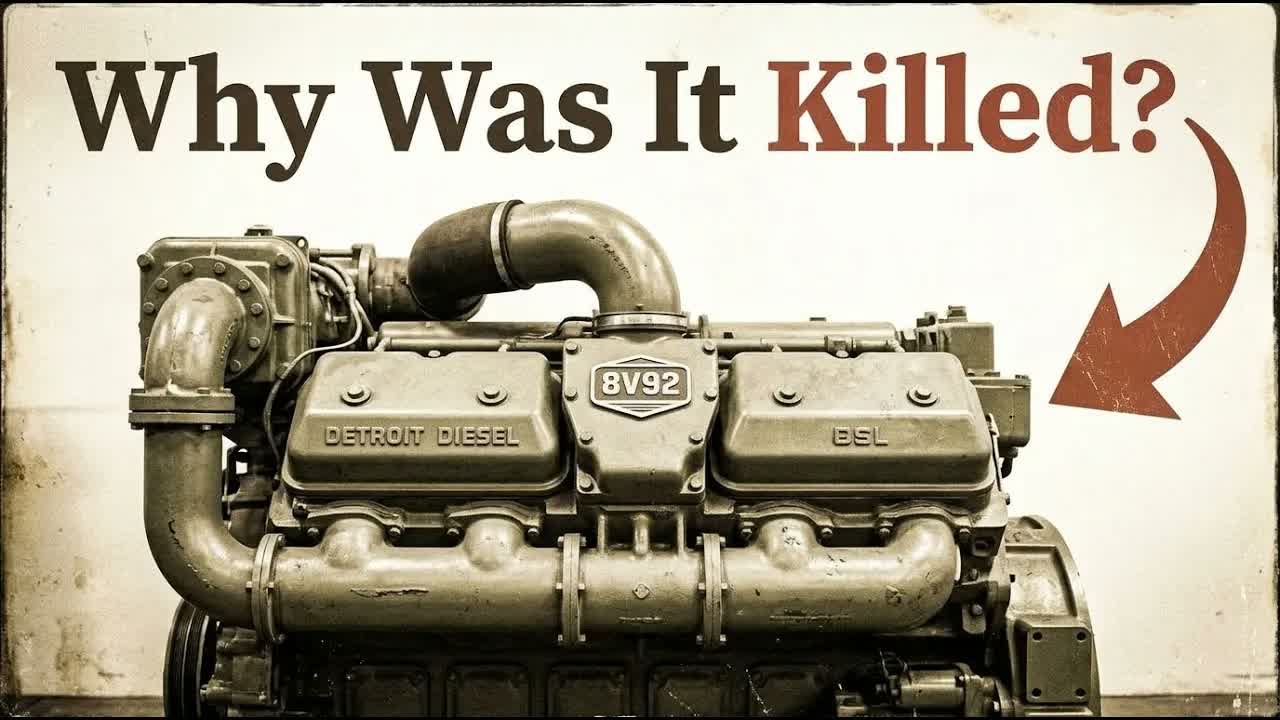
The turning point came from an unexpected direction: the American trucking industry. In the 1930s, long-haul trucking was dominated by gasoline engines that were cheap to buy but expensive to run. A diesel engine cost more upfront but delivered dramatically better fuel economy and durability over hundreds of thousands of miles. Cummins began targeting fleet operators, the companies that ran dozens or hundreds of trucks and cared about cost per mile above all else. The pitch was simple arithmetic. By the late 1930s, Cummins had convinced several major carriers to convert portions of their fleets, and the results spoke for themselves. Trucks equipped with Cummins diesels were covering more miles between overhauls, burning less fuel per ton of cargo, and outlasting their gasoline-powered competitors. The company’s reputation grew, and so did its engineering ambition. When World War II arrived, Cummins engines went into military vehicles, generators, and equipment, and the war effort validated diesel technology on a scale that peacetime never could have. After the war, the American highway system expanded dramatically, and interstate commerce exploded. Long-haul trucking became the backbone of the American supply chain, and the diesel engine became its heart. Cummins was not the only company in the game — Detroit Diesel, Caterpillar, and Mack all competed fiercely — but Cummins had established itself as the engineer’s company, the one that pushed the technology forward. Clessie Cummins himself became something of a legend in the industry, a self-taught mechanic who had bet on the right technology at the right time and refused to let go. He died in 1964, having lived long enough to see diesel engines become the standard power source for American freight. What he built in that cramped Columbus workshop grew into a company that still manufactures engines today, and the technology he championed now moves the overwhelming majority of freight on American roads.

The history of diesel mechanics is, in a sense, the history of the modern American economy. The trade that keeps those engines running — the mechanics who diagnose, repair, and maintain them — became essential the moment diesel became dominant. Early diesel mechanics were often self-taught, learning by trial and error on engines that were finicky and unforgiving. Fuel injection systems required precision that gasoline mechanics had never encountered. Compression ratios were far higher. The tools were different, the tolerances were tighter, and the consequences of a mistake could be catastrophic. Over the decades, diesel technology evolved rapidly. Mechanical fuel injection gave way to electronic controls. Turbochargers became standard. Emissions regulations in the 1990s and 2000s forced dramatic changes in engine design, and mechanics had to learn entirely new systems, new diagnostic tools, and new repair procedures. The trade adapted because it had to. Today, diesel mechanics work on everything from pickup trucks to locomotives, from farm equipment to marine engines, from backup generators to the massive fleets that move goods across the country. The job requires a mix of mechanical intuition, technical training, and comfort with complex electronics. It is not glamorous work. It is often dirty, physically demanding, and performed in extreme weather and difficult conditions. But it is indispensable. The engine Rudolf Diesel built in a German workshop in the 1890s, the engine that vanished with him into the English Channel in 1913, the engine that Clessie Cummins bet his entire company on in 1919, now powers the trucks that stock America’s stores, the trains that haul its freight, the ships that carry its trade, and the generators that keep its hospitals running. Diesel himself wanted to empower the small craftsman. He ended up powering the largest commercial system in the world. The mechanics who keep that system alive inherited a trade built on his invention, and they carry it forward every day, one engine at a time.