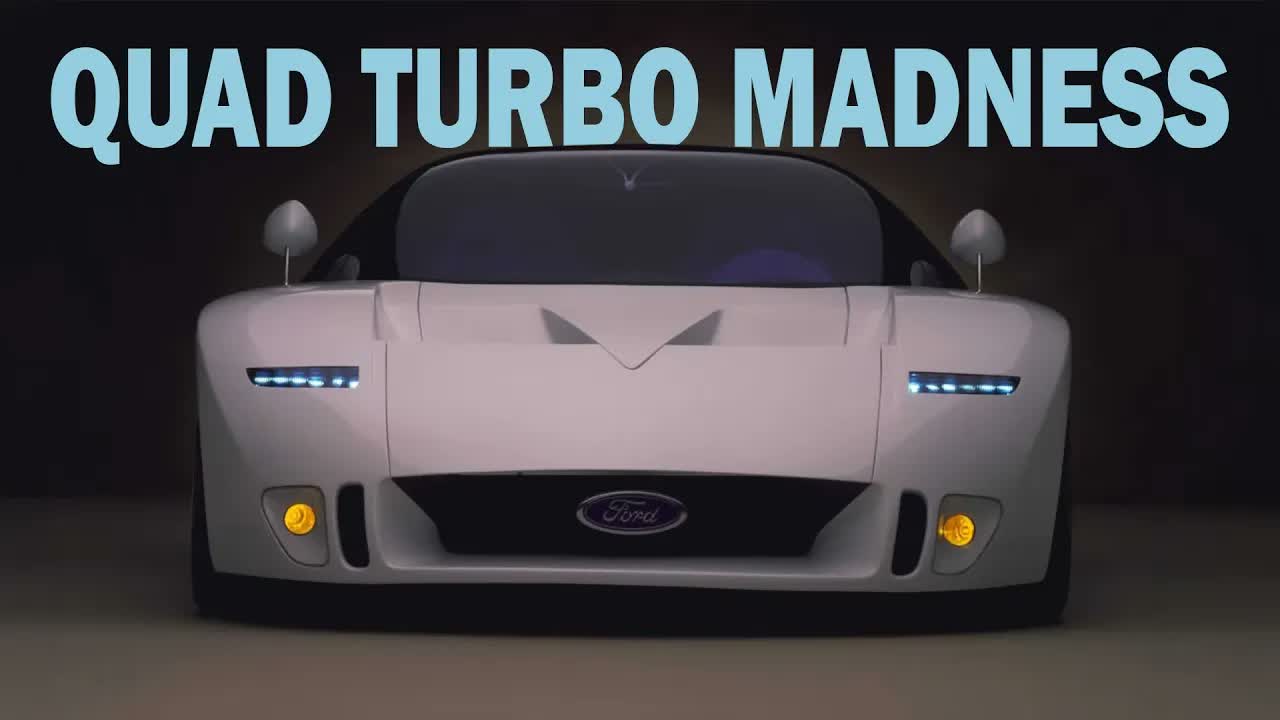
In the often cautious world of American mass-market automaking, the Ford GT90 arrived in 1995 as something close to an act of defiance. Conceived and built under the supervision of John Coletti at Ford’s Special Vehicle Operations division, the concept car was never a rational product plan. It was a mid-engined, quad-turbocharged V12 statement piece unveiled at the Detroit Auto Show, and it carried a claimed 720 horsepower, a projected top speed of 253 mph, and a body so aggressively angular that it seemed designed to argue with the wind rather than slip through it. The GT90 did not emerge from a five-year focus-group process. By most accounts it came together in roughly six months, assembled in secrecy by a small team, and that compressed timeline explains both its magnetism and its contradictions.

The context matters enormously. In 1995 the McLaren F1 already existed, a near-perfect engineering achievement, and Ferrari was preparing the F50 with its Formula 1-derived pedigree. Into that rarefied space came Ford, a company best known for the Taurus, the Escort, the F-Series trucks, and minivans for ordinary families. The GT90 was a wedge-shaped white coupe with blue-tinted glass, triangular exhaust outlets, and a rear deck so heat-intensive that Ford employed ceramic tiles around the exhaust exit area, a solution conceptually similar to the thermal shielding used on spacecraft. Plenty of concept cars get dramatic exhaust pipes; very few require materials that sound as though NASA ought to be consulted before the bodywork begins to melt.
The project’s origins are part of its charm. Ford’s Special Vehicle Operations, led by Coletti, was the kind of department that tended to produce interesting things precisely when it stopped behaving conservatively. The GT90 was developed in strict confidence by a small team, and the widely repeated account holds that it was completed in about six months. That speed was not a luxury but a tactic. Had senior executives learned of the program early, someone might have asked a sensible question and derailed the entire effort. Instead, the team built a running concept car before caution could catch up with ambition.

Beneath the dramatic bodywork, the GT90 borrowed heavily from Ford’s corporate family. Ford owned Jaguar at the time, which meant the concept could draw on ideas and components from the XJ220 program. The chassis design and suspension were linked to Jaguar engineering, and the five-speed manual transmission came from the same orbit. This remains one of the more curious and enjoyable aspects of the car: the most extreme Ford showpiece of the 1990s concealed a British supercar’s underpinnings beneath its American skin.
Then there was the engine, and it was no mere display piece. The V12 was rooted in Ford’s modular engine philosophy, with lineage tracing to the 4.6-liter V8 family, but it was expanded into a 90-degree V12 and fitted with four Garrett turbochargers. Roush participated in development and testing, which was inevitable; if you are going to build a wildly powerful Ford concept, someone from Roush will eventually appear with tools and a slightly alarming smile. The announced output was 720 horsepower and 660 lb-ft of torque, with an engine speed range reaching 6,300 rpm. Those figures were extraordinary in the mid-1990s, and they remain extraordinary today. Ford also claimed a 0-60 mph time of about 3.1 seconds, 0-100 mph in 6.2 seconds, and that 253 mph top speed. Such numbers deserve caution, because the GT90 was a concept car, not a fully developed production vehicle with customer testing, independent verification, warranty support, and thousands of miles of public trials. But the point was never the stopwatch. The point was that Ford wanted the world to believe it could build something worthy of mention alongside the most extreme supercars on the planet.

The design was at least as significant as the numbers. The GT90 introduced Ford’s New Edge design language before the public truly understood what it was. Later, in cars such as the Cougar and the Focus, New Edge meant intersecting curves, sharp creases, triangular forms, and a sense that ordinary car shapes had been ambushed by geometry. On the GT90, that language was so loud it nearly required ear protection. Everything was a point, a blade, a cut, a vent, or an angle. The car featured blue-tinted glass, a white body, doors cut into the roof as a nod to the GT40, and a rear design with four exhaust outlets arranged in a triangle because a conventional rectangle apparently seemed too timid. It was meant to be the spiritual heir to the GT40, yet it was not classic in the comfortable way the 2005 Ford GT later would be. The GT90 had no interest in making older enthusiasts nostalgic at Goodwood. It did not quote the past politely while wearing polished leather shoes. It took the GT40 idea, a low, mid-engined, rebellious American car, and launched it toward the future without checking whether the future was ready.
That is precisely what makes it interesting. The GT90 was not mere nostalgia; it was closer to a sharp argument. It suggested that the GT40’s legacy did not have to mean round headlights, racing stripes, and emotional memories of the 1960s. It could also mean a wedge with a quad-turbo V12 radiating enough heat to threaten the surrounding wildlife. The 2005 Ford GT later proved that retro design could be executed brilliantly, but the GT90 proved that Ford had also considered taking the opposite direction entirely.

Inside, the cabin was equally strange. Blue was everywhere, consistent with the exterior treatment. The gear lever looked like an industrial sculpture, and the steering wheel appeared to come straight from a Focus. There were buttons, angles, vents, and an atmosphere somewhere between concept-car optimism and an expensive gaming chair from another planet. It was not warm in the traditional grand-touring sense, nor luxurious like a Bentley inviting you to sink into leather and discuss real estate prices. It was theatrical. It looked like the interior of a supercar imagined by people who had just discovered early computer graphics and decided that curves were a weakness. That captures the 1990s precisely. The GT90 did not look hand-drawn in the old romantic way. It looked digital before cars became fully digital objects. It carried an engineering confidence suited to the era of compact discs, video games, early three-dimensional graphics, and posters of machines that seemed too strange to exist. That is part of why the car worked so well later in games: it already looked like something that belonged on a screen.
The central problem with the GT90 is that it existed in the gap between being a statement and being a product. As a statement, it was magnificent. It said Ford could imagine a supercar before the word itself had become part of everyday automotive language. It said the company that built millions of ordinary vehicles could still enter the supercar arena and silence the room. It said New Edge was not merely a styling pattern for hatchbacks but a complete philosophy of hard technical confidence. As a product, however, the matter was far more difficult. Producing the GT90 would have been expensive, complex, hot, uncomfortable, and possibly very hard to make behave like something a customer could own without a dedicated emergency response team. The world had already watched the Jaguar XJ220 struggle with changed promises, awkward marketing timing, and supercar economics. The early 1990s were not kind to supercar imagination. The McLaren F1 was a masterpiece but barely achieved broad commercial success. The Ferrari F50 carried the Ferrari badge and a Formula 1 connection, and even that ended up controversial. A Ford with a quad-turbo V12 and a ceramic heat shield would have been spectacular, but spectacular does not automatically pass emissions and warranty testing, development standards, production engineering, or dealer reality.

That is why the GT90’s reputation is so peculiar. It is one of those concept cars people wish had been built, while knowing that if it had been, it might well have become a nightmare. So how should the GT90 be judged? Not as a failed production car, because Ford never actually pushed it as one. Not as a proven race-track conqueror, because its boldest performance claims belong to the world of concept cars. And not as a mere silly design exercise, because real engineering sat beneath the surface: a carbon-fiber structure, an aluminum honeycomb chassis, Jaguar-derived components, a bespoke quad-turbo V12, serious performance intentions, and enough thermal management trouble to make the rear end resemble a science experiment with number plates. The right way to judge the GT90 is as a declaration of capability and a snapshot of a specific moment, when a large American manufacturer allowed a small, secretive team to build something beautiful, excessive, clever, and slightly unbalanced. It never needed to reach showrooms to succeed. It only needed to make people reconsider what Ford could be, and on that measure, the GT90 delivered.