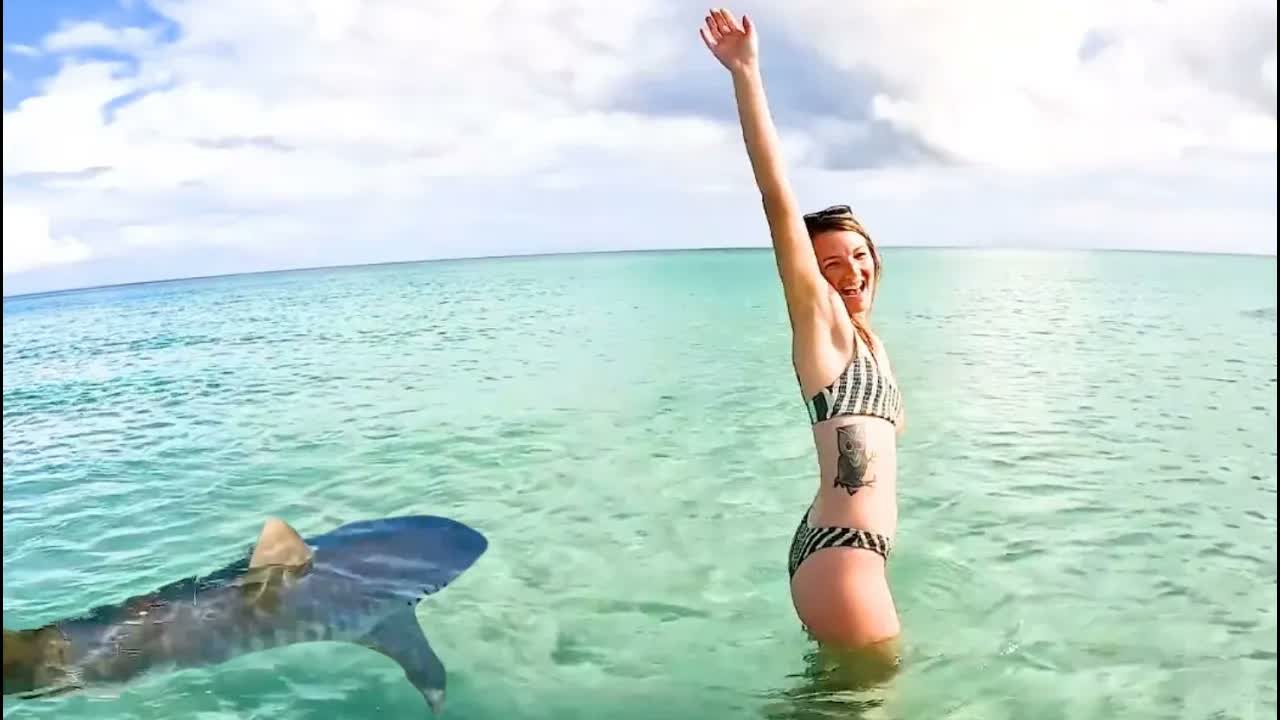
A small team of marine scientists working off the remote Ningaloo Reef, on the far north-west coast of Western Australia, published a modest statistical paper in 2008. It was not a count of fish. It was a count of wounds. Led by Conrad Speed, working alongside Mark Meekan and colleagues, the team examined the photo-identification library of whale sharks that gather at Ningaloo each year and looked at every animal the way a medical examiner looks at a case file: scratches, abrasions, lacerations, amputations, bites. What they found was striking. Forty-four per cent of Ningaloo’s whale sharks carried scars consistent with predator attacks — nearly half of them. And the scars were not spread evenly across the body. They clustered at the tail more than anywhere else.
Twelve years later, the Australian Institute of Marine Science returned with a much larger sample. A study published in 2020 examined 913 whale sharks photographed by tour boats between 2008 and 2013. Of those, 146 carried serious injuries. So we have the photographs, the percentages, and the location on the body. What we do not have, in any of those papers, is the creature that caused the bites. The field marked “predator” was left blank. There is a reason that field is never filled in, and it has nothing to do with a lack of curiosity. Whale sharks have negative buoyancy. When one dies, it does not float to the surface and drift to a beach where someone can examine it. It sinks. That means every animal in that dataset is one of the survivors. The ones that could tell us what preys on the largest fish on Earth are resting on the seafloor. They have been there all along.

It is worth starting with the animal itself rather than the predator, because size matters here. The whale shark is the largest living fish. An adult can reach roughly 18 metres in length and weigh more than 30 tonnes — larger than most whales. It feeds by filtering plankton and krill from the water. For an animal of that size, its brain is remarkably small; one scientist quoted in this story described it as about the size of an egg. This is not a fragile creature, and it is not an animal confined to shallow water. Whale sharks have been tracked diving to two kilometres, though they spend most of their time near the surface. At Ningaloo, tracking studies found they remain at the surface for about 60 per cent of their time.
Then there is the detail that makes this whole story possible. Most bony fish possess a swim bladder, a gas-filled organ that lets them hang in the water without effort. Sharks do not have one. The whale shark is denser than the water around it, so it sinks. Scientists at the Australian Institute of Marine Science concluded that this is not a defect but a strategy. The whale shark lets itself glide down into deep water to feed, expending almost no energy on the way, then powers its way back up. That oscillating pattern saves it as much as 30 per cent of the energy it would spend swimming horizontally. Some researchers believe it is part of the reason the species grew enormous in the first place. So the same feature that makes the whale shark an efficient animal in life makes it vanish in death. A dead whale shark does not wash ashore, and it does not bloat at the surface where a fisherman might find it. It drops beyond the reef edge and the continental slope into depths no one photographs. Keep that in mind, because everything that follows depends on it.
Here is how the census works, because the methodology is part of the story. Every whale shark carries a pattern of spots and pale stripes behind its gills. It is unique, like a fingerprint. Photograph that patch and you can identify the same animal year after year, across seasons and sometimes across oceans. At Ningaloo, most of those photographs do not come from scientists. They come from the tourism sector. Each season, boats take tourist divers to swim alongside the sharks, guided by spotter planes. Whale shark tourism is estimated to be worth around 12.5 million dollars a year to the region. The identification library was built by thousands of incidental witnesses — crew, guides and tourists with their underwater cameras, people who came for a holiday and ended up contributing to a dataset. The 2008 study compared Ningaloo with two other whale shark aggregations, one in the Seychelles and one in Mozambique, and classified each scar by type. Boat strikes leave blunt impacts and straight, parallel wounds. Predators leave something else. At Ningaloo, predator bites were more common than at the other two sites: 44 per cent of individuals carried them. Across all three aggregations, the scars appeared mostly in the same place — the caudal fin, the tail. On a large adult, the tail can be wider than a human is tall. Whatever closed its jaws on that was not small.

Picture one of those images: a tail fin, grey and spotted, with a jagged trailing edge where a piece is missing. Above it, a pale arc of healed tissue, the curve of a jaw pressed onto skin ten centimetres thick and then pulled away. It is not a fresh wound. It healed seasons ago. The animal swam into the frame, swam out of it, and came back the following year. The study gave the cause a single word: predators. Then it stopped there. Here is another result from the same paper that I keep returning to. The scars had no measurable effect on survival rates. Scarred sharks returned to Ningaloo season after season at the same rate as unscarred ones. In other words, the animals in the database carry the mark of a bite, and that bite did not stop them. Which raises a question no one in the methodology section dares to ask out loud. What happened to the ones it did stop?
During the Second World War, the US military asked a simple question of a statistician named Abraham Wald. Where should we add armour to our bombers? The engineers had data. They mapped bullet holes on every aircraft that returned from a mission. The holes clustered on the wings and fuselage. The intuitive answer was to armour those areas. Wald said no. Armour the places where there are no holes. The aircraft in the dataset were the ones that survived. A bomber hit in the engine did not make it home to be counted. The bullet holes did not show where planes were hit. They showed where a plane could be hit and still come back. Now look at the whale sharks again. The bites cluster on the tail. The intuitive reading is that predators target the tail. Wald’s reading is different. The tail is where a whale shark can be bitten and live. The photo library does not record where attacks happen. It records the attacks that failed. When the Australian Institute of Marine Science published its broader study in 2020, lead author Emily Lester was speaking about ship strikes, not predators. But she said something that applies to every column in that table. The study, she said, could only document the sharks that survived their injuries. To me, that is the most chilling sentence in the methodology. A scar is not really a record of an attack. It is the shape of something unfinished.
So let us try to fill the blank ourselves. Who could have caused these bites? The first candidate is the tiger shark. It is common in the warm waters of north-west Australia and is a generalist predator that will try to eat almost anything. Its teeth are serrated and curved, built for sawing through turtle shell. It is plausible that a tiger shark would leave a crescent mark on a whale shark’s tail. But a large tiger shark is only a fraction of the size of an adult whale shark. That might explain some of the smaller scars, but it would struggle to explain the large ones. The second candidate is the great white shark. It does occur along the West Australian coast and has a suitable bite radius. But great whites generally prefer cooler water than Ningaloo’s, and no one has ever observed a great white attacking there. It explains the larger scars, but it does not fit the place. The third candidate is the killer whale. Orcas pass through this coastline and are known to hunt large prey in Western Australian waters. They hunt in groups, which solves the problem of size. A pod can do what a single animal cannot. But orca teeth are conical rather than serrated, and they tend to leave parallel scratch marks, not a clean crescent. The orca fits some scars and not others. Every suspect explains part of the record. None explains all of it.

Now add the strangest part. Ningaloo is one of the most closely watched stretches of ocean in the world. Every season, for decades, there have been boats on the water, aircraft in the sky and people swimming beside these animals for hours a day. That means thousands of witnesses carrying cameras, year after year. As far as I can find, the published record contains no case of a whale shark being preyed upon at Ningaloo. Not one documented attack, not one kill. Nearly half the animals carry bite scars, and no one has ever seen a bite happen. I want to be careful here. What I am describing is not a cover-up. It is ordinary science working the way it is supposed to work. But the pattern is worth noticing. When the Australian Institute of Marine Science reviewed 913 sharks, it found 146 with serious injuries, about 16 per cent. Serious injuries became more common over the study period, roughly doubling in 2012 and 2013 compared with 2011. The headline was not predators. It was boats. The researchers said most of the large scars appeared to result from blunt impacts, lacerations and amputations caused by collisions with vessels, especially propellers. Some were probably predator bite marks. Probably. That is a reasoned inference. Propellers leave a distinctive signature, shipping traffic in the region is increasing, and a vessel can wound an animal that never comes close to being counted as prey.
There is a further layer to this that deserves attention, because it concerns the reliability of the record itself. The photographs that make the Ningaloo library possible are taken by people whose primary purpose is tourism, not research. That is not a criticism; it is simply a description of how the data was assembled. It means the sample is shaped by where boats go, when they go, and which animals are willing to stay near swimmers. A shy or badly injured shark may never be photographed at all. An animal that dies at sea is never photographed again. The dataset is therefore not a random sample of the population. It is a sample of the visible, the tolerant and the surviving. None of this invalidates the findings. It simply defines their limits, and the researchers themselves have been explicit about those limits.
What remains, then, is a remarkable kind of scientific humility. We have a precise count of wounds on the largest fish in the sea. We have their locations, their frequencies and their trends over time. We have a plausible list of suspects, each matching part of the evidence. What we lack is the one thing that would settle the question: a body. The whale shark’s own biology ensures that the evidence of its death is removed from view, sinking quietly beyond the reef into water no camera reaches. The animals that survive carry the record on their skin, and the animals that do not take the answer with them. It is a reminder that a blank field in a data table is not always an oversight. Sometimes it is an honest admission that the ocean has kept something to itself, and that the survivors, however numerous, can only ever tell part of the story.

Report
Report this article
×
Select a reason for reporting: