The story that has circulated for decades begins with a fleet of twelve shark fishing boats working the Pacific coast of Baja California, and with a captain named Aurelio who had spent nineteen years running the outer shelf route. On the morning of September 3, 1996, Aurelio radioed the other eleven boats and asked them to come and look at something. By the time they arrived, he was standing at the stern of his boat, silent. He did not need to say anything. They could all see it. By that evening, all twelve boats had returned to port. None of them went out the next day. None went out the day after that. For eleven days, the entire fleet stayed in harbor. The harbor master recorded it as a weather delay. According to the captains’ later accounts, the weather that week was clear and calm, but the harbor master wrote “weather delay” anyway, because that was an acceptable excuse in the records. Fish buyers waited on the dock for eleven days and nobody came. When the boats finally went out, they headed north. They fished different waters for the rest of that season, and they never returned as a fleet to those grounds. Some boats eventually came back individually. The rest found reasons not to.
Every official record points to a weather delay. But every man on that dock knew the weather was perfect. The account that follows draws on two principal sources: a written statement taken by a regional fisheries inspector in 1997, and a recording made in 2003 in a cantina outside Ensenada, where three of the captains spoke together for the first time since the incident. The two accounts do not contradict each other. They describe the same thing, with the same numbers. Some researchers might call that unusual. Witnesses who invent legends often see their stories drift apart over time, while the accounts of these men matched. The place matters here, so it is worth describing precisely. The Pacific coast of Baja California stretches roughly 1,250 kilometers from the U.S. border south to the tip of the peninsula. It is not a gentle coast. The Pacific side faces open ocean: long gray swells rolling in from vast distances, cold upwelling driven northward by the California Current, and water temperatures that stay cold even in September. The continental shelf off the outer Baja coast is narrow and compressed, then drops sharply at the Cedros slope and beyond into the deep ocean basin. Where the shelf edge breaks, depth increases from 200 meters to more than 2,000 meters within a few miles. That transition zone, where cold deep water pushes up toward the warm surface layer, where nutrients mix and food chains concentrate, is exactly the kind of water that large predators follow.

By the mid-1990s, shark fishing along this coast had been going on more or less continuously for more than a hundred years. Since the mid-1970s, Mexico had become a world leader in shark fishing, with roots reaching back to the first shark fin exports from La Paz in the late nineteenth century. By the early 1990s, the blue shark had become the main target species in the artisanal longline fishery along the western coast of the Baja peninsula, using boats about 25 feet long. The captains who worked these grounds were not hobby fishermen. They were commercial operators who had spent their careers reading water, managing gear, and making economic decisions based on what the ocean gave them. These were men who understood risk and return. These were men who knew sharks well. What they did not know, in a professional sense, was how to fit what they saw on the morning of September 3, 1996, into anything in their experience, because nothing in their experience had prepared them for it. That detail matters. The first boat on the scene was commanded by a man named Aurelio. He had worked the outer shelf route for nineteen years. He was not a man inclined to panic. His mate saw it on the surface first: a shape about two kilometers away that, from that distance, looked like a tidal disturbance or a current line, the kind of surface turbulence that occurs where two water masses meet. Aurelio adjusted course slightly to avoid it. Standard practice is not to run your gear through a tidal disturbance. As they closed the distance, the shape did not resolve into a tidal disturbance. It resolved into a surface pattern produced by an animal, a very large animal moving slowly at the surface in the calm September swell, its dorsal fin breaking above the water and its body visible beneath it in the clear morning light. Aurelio cut the engine. He stood at the wheelhouse window and watched it for about two minutes before he picked up the radio. He said in his 1997 statement to the inspector: “I did not know what to say over the radio. I picked up the handset and I did not know what words to use. I told the others, come and see this. I said it three times. Then I put the radio aside and kept watching.”
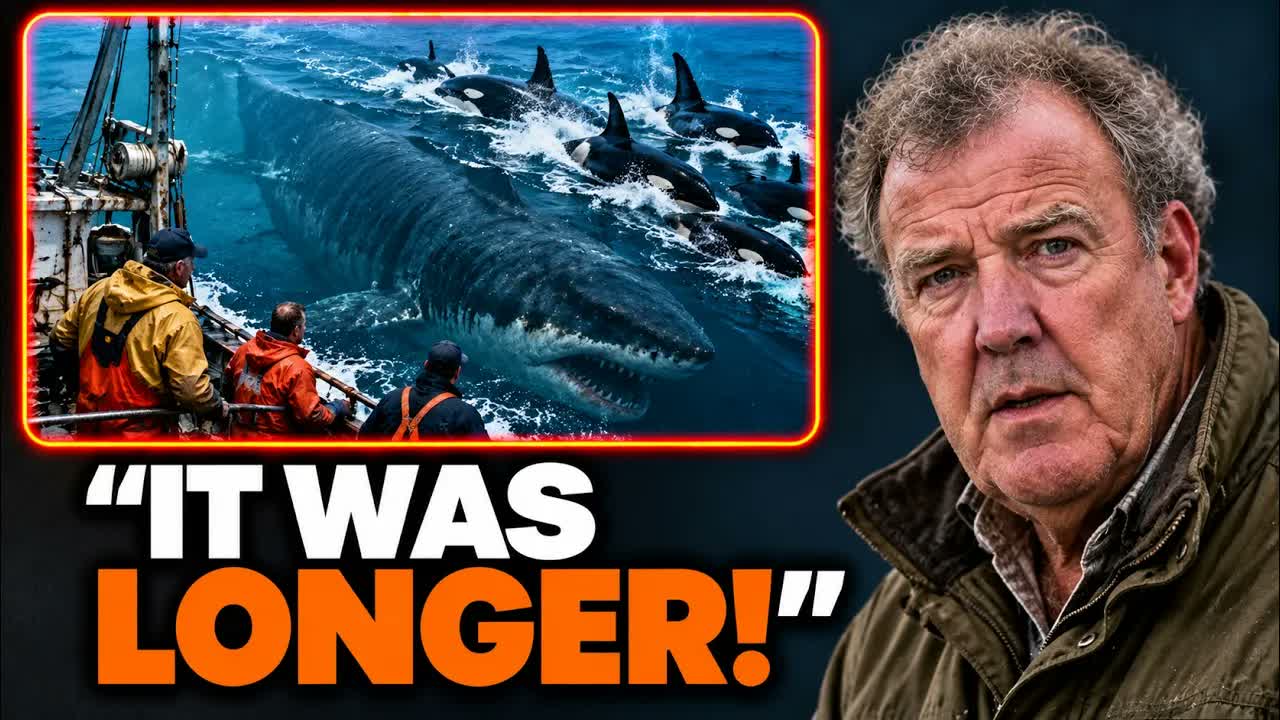
The other eleven boats came. They arrived over the next forty minutes, forming a wide arc at a distance none of them calculated consciously but which, described later, ranged from 300 to 500 meters from the animal. None of the twelve boats came closer than 300 meters. They simply stopped there, the way animals stop at a certain distance from something they do not understand. The animal stayed at the surface for about two hours and forty minutes. It did not move quickly. It moved the way large animals move when the water and the morning are calm and there is no particular reason to go anywhere. Slow, continuous, the tail working in long arcs beneath the surface, the body barely undulating. The dorsal fin stayed out of the water for most of the sighting. The pectoral fins were visible beneath the surface on either side of the body, broad and dark, moving slightly to maintain balance. One of the youngest people present was a hand on a boat named Tomás, on one of the outer boats, nineteen years old, in his first full season on the outer shelf route. He had grown up on the coast. He had been around boats and fish all his life. He had seen large sharks before, blues, makos, and the occasional thresher. His captain, in the 2003 cantina recording, described him standing at the bow of the boat for the entire two hours and forty minutes, not talking, not moving, just watching. He said Tomás was not afraid when the season began. He said Tomás had seen bull sharks attack longlines and had not blinked. He said the boy who stood at the bow that morning was not the same boy he had hired in June. He said: when we got back to port that evening, Tomás called his mother. He stood on the dock and called his mother. I had never seen him do that before. That was the least of what changed.
According to three of the captains who later compared notes, each independently used the fleet’s boats as a reference and arrived at a similar number. This is the part of the case worth focusing on, because independent arrival at the same measurement is the hardest thing to explain away. The reference they used was the fleet itself. The twelve boats ranged from 8 to 14 meters in length. The captains knew each other’s vessels the way neighbors know each other’s houses. They knew exactly the length of Aurelio’s boat, the length of the Santiago brothers’ boat, and the length of the longest vessel in the fleet. These were not estimated dimensions. These were boats they had tied up beside a thousand times, boats they had helped moor, boats whose waterlines they had compared with their own for twenty years. Each captain used the other boats as a ruler, comparing the visible length of the creature against the spread of the fleet and calculating the animal’s total body length from known hull lengths. The longest vessel in the fleet was 14 meters, a little over 45 feet. The captain of that vessel was named Gustavo, the person who spoke most precisely about this in the 2003 recording. He said: I put my own boat beside it. I know my boat. I have fished in it for eleven years. The creature in the water was as long as 8 to 9 of my boats from nose to the point where the tail went under. 8 to 9 of my boats. I did not write that down. I did not need to write it down. Eight times 14 meters is 112 meters. Nine times 14 meters is 126 meters. The middle of that range is roughly 119 meters. That is about 390 feet. Gustavo, in the recording, rounded the figure to 120 meters when he told the other captains at the table, because 120 meters is a number the human mind can absorb, and because extreme precision was not the point. The point was that every captain at that table had independently arrived at a figure in the same range, using different vessels of their fleet as measuring tools. A man inventing a legend does not check his estimates with eleven other witnesses and come out with a consistent result. The figure at the center of this account, roughly 120 feet, or about 36 meters, is far beyond what mainstream marine biology accepts as possible for any known shark. Estimates for the maximum size of the extinct Otodus megalodon vary widely in the scientific literature, with many modern reconstructions placing even the largest adults well below the extremes once popularized in documentaries and fiction. That gap between what the captains reported and what biology says can exist is precisely what makes the case enduring, and precisely why it remains unresolved. No physical evidence was recovered. No photograph from that morning has ever surfaced. What exists is a fisheries inspector’s written statement, a cantina recording, and twelve captains who, by their own account, chose different water for the rest of that season. The harbor master’s log still reads “weather delay.” It is, in its way, both the most honest and the most dishonest entry in the entire file.

Decades later, the men who were on the water that morning have largely kept to their own accounts, and the official record has never changed. Whether the fleet encountered an animal of extraordinary size, misjudged a familiar shape in difficult light, or something else entirely, the documentary trail remains thin and the testimony remains remarkably consistent. For researchers, the case sits at an uncomfortable intersection: too specific to dismiss casually, too extraordinary to accept without evidence. For the captains and their crews, the memory is simpler. They saw something on a calm September morning, they measured it against the boats they trusted, and then they went north and did not come back. The weather, as everyone on that dock knew, was perfect.
Report
Report this article
×
Select a reason for reporting: