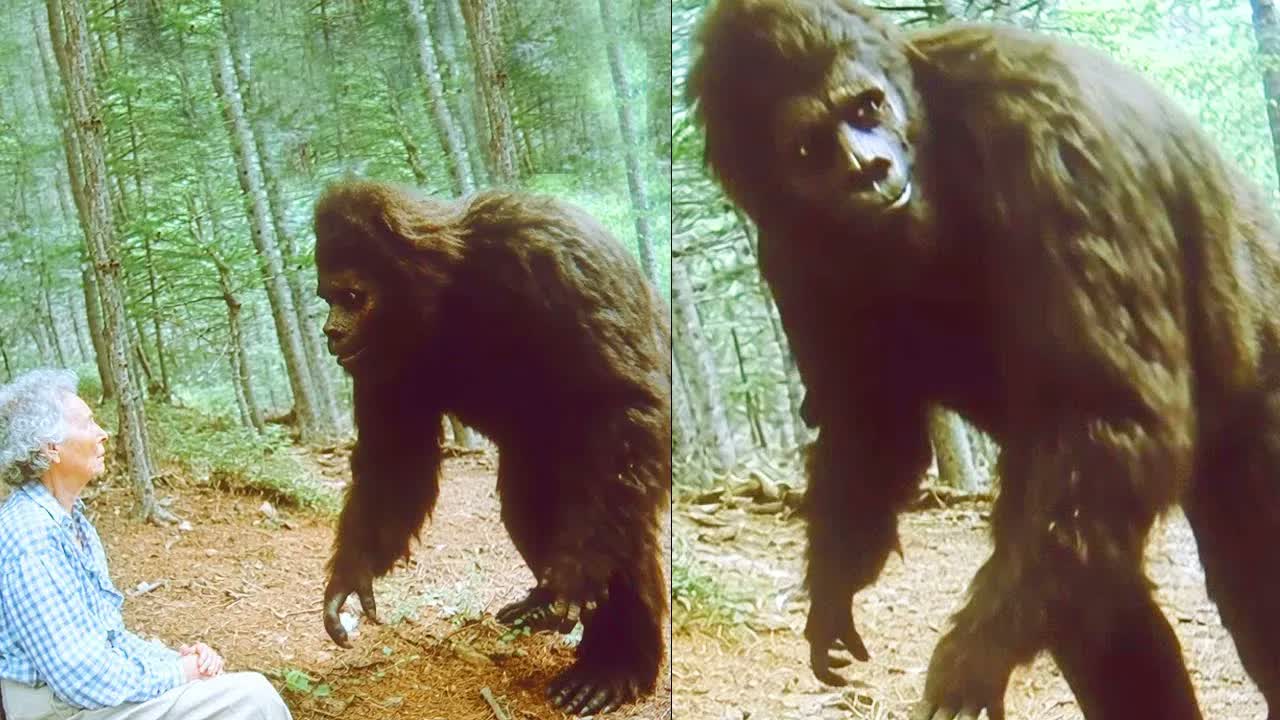
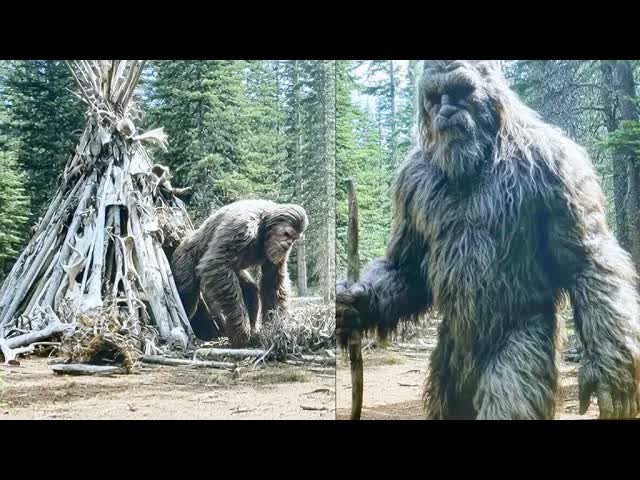
The Albert Ostman case has long occupied a peculiar place in the literature of North American Sasquatch reports: frequently cited, widely doubted, and never entirely dismissed. Ostman, a Swedish immigrant who spent his adult life in logging camps and construction sites across British Columbia, claimed that in the summer of 1924 he was carried off in his sleeping bag by a large bipedal primate and held for six days in a secluded valley before escaping. For decades, skeptics treated the account as a tall tale that had hardened into legend, while a smaller group of investigators regarded it as one of the most internally consistent narratives of its kind on record. Now, according to investigators associated with the ongoing review of the case, new evidence has emerged that supporters say strengthens the account’s credibility and, at the same time, raises a fresh and unexpected question about the behavior of the creature Ostman described.

The core of the new material, as summarized in a recent presentation circulating among researchers, concerns what Ostman reportedly witnessed during his captivity that does not fit conventional assumptions about Sasquatch behavior. The claim is not that the creature was seen again, nor that physical traces have been recovered from the site. Rather, the argument is that details embedded in Ostman’s earliest testimony, recorded decades before modern primate anatomy entered general circulation, describe a physical feature and a set of social behaviors that no ordinary hoaxer of his era would plausibly have invented. The presentation asserts that this constitutes evidence Ostman was one of the first people to describe a Sasquatch in detail, and that the account has survived scrutiny in a way few comparable reports have.

The narrative itself begins in 1924, when Ostman was 31 years old. He traveled to Toba Inlet, on the British Columbia coast, to search for a lost gold mine. He hired an Indigenous guide to boat him to the head of the inlet, then made camp at the mouth of a creek. Before departing, the guide mentioned that the mountains above the inlet were home to beings his people called Sasquatch. Ostman, by his own account, dismissed the warning. He prospected for several days without success, cooking rice, boiling prunes, and making flapjacks. Investigators who have studied the case often point to the mundane specificity of those details as a point in its favor, on the reasoning that fabricators tend to build toward the dramatic while Ostman described tugboats and flapjacks.
The disturbances began on the fourth night. Something entered his pack and took prunes and part of his pancake flour, but nothing was torn or scattered, and his salt was left untouched. Porcupines, the default explanation for raided camp supplies, go straight for salt. Whatever visited, Ostman said, sorted through his supplies with unusual precision. After three nights of the same pattern, he loaded his rifle, packed his boots inside his sleeping bag, and resolved to stay awake. He fell asleep anyway. When he woke, he was already moving, having been picked up inside the sleeping bag and carried upright. The gait was bipedal, with a rise and fall rhythm that Ostman said no four-legged animal produces. One boot had come crossways, its hobnail sole grinding into the arch of his foot, and he could not shift position to relieve the pain. His carrier, he said, managed the pack simultaneously, and Ostman could feel the cans against his back for the entire journey.
The trip lasted close to an hour: steep uphill first, then level ground at a trot, then downhill. The carrier breathed hard on the ascent and occasionally coughed. The opening at the top of the bag admitted just enough air to keep him alive, and Ostman later observed that had it been sealed completely, he would not have survived. When the carrier set him down, the bag rolled. He worked his head out and tried to restore feeling to his legs while listening. What he heard, he said, were voices, not mere sounds: structured communication from multiple distinct sources in what he described as an exchange. It was still dark. By the time light came up, he was in a small enclosed valley of eight to ten acres, surrounded by vertical terrain on all sides, with a single exit, a V-shaped gap on the southeast face roughly eight feet wide at the base and twenty feet high at its opening.

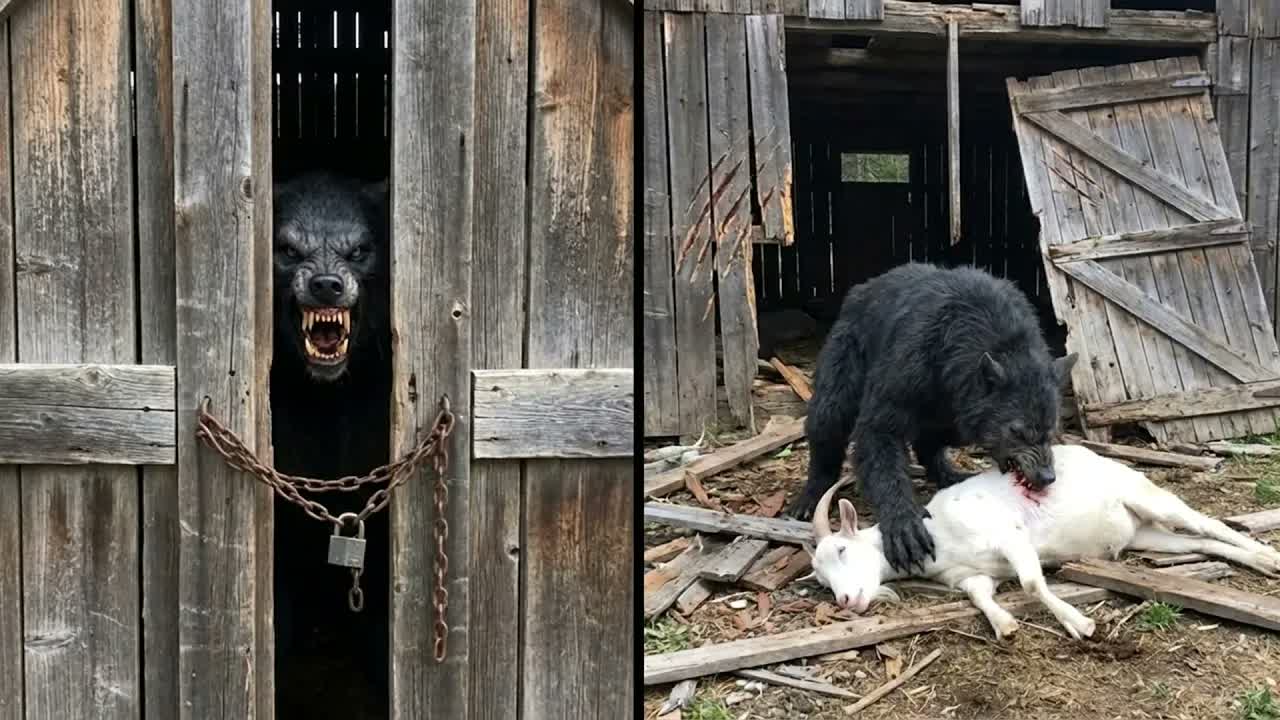
Four creatures were present, according to the account. The adult male, sitting beside the gap when Ostman first saw him clearly, stood close to eight feet tall. His forehead slanted upward toward the back, with the rear of the skull sitting four or five inches higher than the front. Ostman had no term for what he was describing, but the feature he outlined in plain language corresponds to a sagittal crest, the bony ridge along the midline of the skull found in gorillas and other large primates, which provides surface area for the jaw muscles that generate extreme bite force. The adult male’s hands were wide with hollow palms, his fingers short relative to the palm, and his nails thick as chisel blades. The adult female stood over seven feet tall and weighed, by Ostman’s estimate, between 500 and 600 pounds, with a wide-hipped gait consistent with a very large bipedal primate. The young male, about seven feet tall and roughly 300 pounds, was curious, mimicked Ostman’s movements, and accepted food cautiously. The young female stayed back and watched without approaching.
Ostman said he spent six days in that valley, never harmed and never unobserved. The adult male held a position near the gap every day, and the canyon walls were vertical, leaving no other route out. The escape, according to the account, came through snuff. Ostman was a daily user, and the adult male had watched him take a morning pinch with evident curiosity. On the sixth morning, Ostman left the box where the male would find it. The male swallowed the entire contents at once, then coughed and gagged and sprinted toward a spring at the far end of the valley, away from the gap. Ostman packed, loaded his rifle, and walked to the exit. The adult female moved toward him, and he fired once over her head. She stopped. He went through the gap and ran. Several hours of rough terrain later, he reached a logging camp and told the men he was a prospector who had gotten lost, and nothing else. He ate, slept, and spent the next 33 years deciding to say nothing at all.

When Ostman finally told his story publicly in 1957, he told it to John Green, a former newspaper editor turned Sasquatch investigator. Green was not a believer; he was a newspaperman trained to evaluate whether people were telling the truth, and he applied that training directly. What Green found, by his own account, was that Ostman answered questions the way people retrieve memory rather than the way people recite a rehearsed narrative. Details were consistent across multiple conversations spanning years, not in the polished manner of a refined story but in the textured, uneven manner of actual recollection. Green later stated that he had never caught Ostman contradicting himself, hedging on implausible details, or showing any sign that the account had been constructed, and Green had rejected numerous Bigfoot claims on exactly those grounds.
The formal examination was conducted by A. M. Naismith, a police magistrate, coroner, and justice of the peace in British Columbia. Naismith cross-examined Ostman in an official capacity, a structured process designed to find deception, inconsistency, or embellishment. His written assessment afterward stated that he had applied every available method and found no flaw in the personality or the story, and he concluded that Ostman believed what he was saying and appeared to be telling the truth. Ostman also signed a sworn statutory declaration, legally binding and subject to perjury charges if false, and he signed it without hesitation. Rene Dahinden, a Swiss-Canadian investigator known for aggressive skepticism and for identifying hoaxes, reviewed the account and reached the same conclusion as Green. According to the case record, the story never changed, not once.

The new evidence presented by investigators is unlikely to settle the question. The Ostman case remains, by its nature, a single-witness account from a remote location nearly a century ago, unsupported by physical remains and dependent on the credibility of a man who is no longer alive to be questioned. What the new material does accomplish, its proponents argue, is to sharpen the case’s central anomaly: the anatomical and behavioral details Ostman described, which align with documented primate patterns that he had no academic framework to invent, and which he reportedly never altered across decades of interviews, a sworn declaration, and formal cross-examination. Whether that constitutes proof is a matter for each reader to weigh. What it undeniably constitutes is a renewed reason to look closely at one of the most durable and least easily explained accounts in the literature of the Sasquatch, and at the unsettling possibility that the creature Ostman described was capable of something investigators had not previously considered.