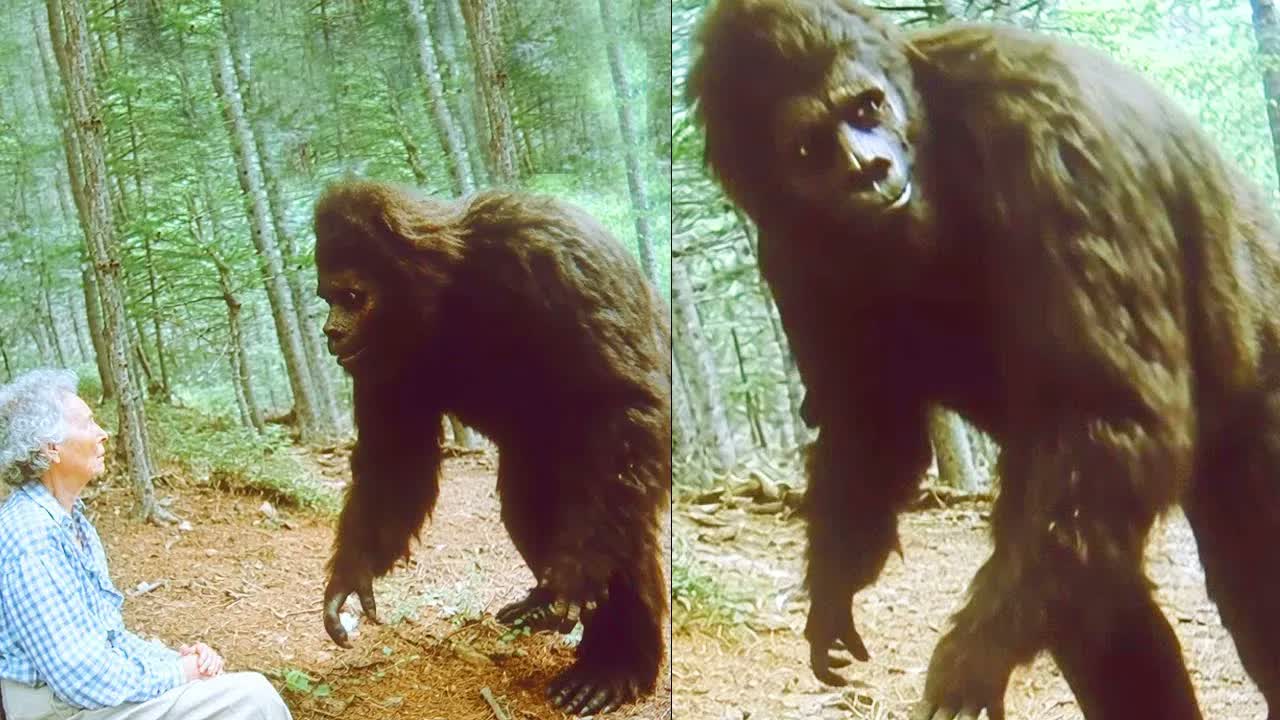
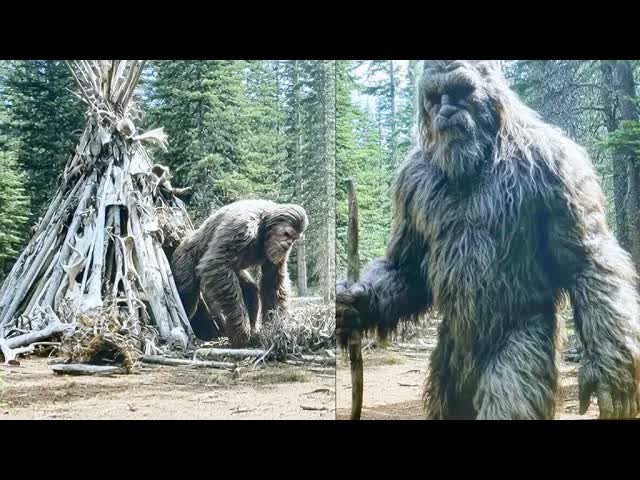
The 2013 footage near the Tennessee–Georgia border remains one of the most widely discussed clips in the long-running debate over Bigfoot, the large, upright primate-like figure said to inhabit remote forests of North America. A hiker described filming the encounter while bird watching on April 21st, 2013, and the resulting video shows a dark, tall shape standing among trees in lush green forest before it moves out of view. The camera sweeps across dense trunks in an attempt to find it again, but only the natural sounds of the forest remain. More than a minute later, movement reappears farther off in the brush, and the person filming refocuses through the branches before the figure vanishes completely, as if it had never been there at all. According to the individual who uploaded the clip, the creature stood well above nine feet tall, a height no ordinary human being can reach. Skeptics have raised a counterpoint that is difficult to ignore: the birds kept chirping as usual, whereas in many reported Bigfoot sightings the forest is said to go suddenly and completely quiet.

Ohio in 2012 offered a different kind of scene entirely. A winter that would not let up had buried the countryside under lake effect snow for days, turning familiar tree lines into something unrecognizable and the ground into a blank page scrawled with tracks nobody could place. There were deer prints, dog prints, and something else — something bigger, spaced wider, pressed deeper into the drifts than anything on four legs should be. Someone grabbed a handheld camera and went looking. The footage opens with the lens sweeping low and slow across the frozen terrain, snow piled in uneven mounds where wind had carved it into ridges. The silence is the kind that only exists after a heavy storm: no birds, no wind, just the crunch of the operator’s own footsteps. Then the camera stops panning and focuses on the brush ahead. Something upright is moving — not walking the way a person walks, but moving the way something built differently moves, with a slow, deliberate weight. Against the snow-laden trees, the figure looks massive, dark, and disproportionate to everything around it. It does not pause and does not turn toward the camera. It simply keeps going, pushing through the thicket as though the deep snow pack barely registers. The clip, later uploaded by the How to 101 channel, holds on this single sighting rather than cutting away, letting the shape work its way through the dense winter brush for several long seconds. There is no zoom and no stabilization, just the raw, imperfect record of something crossing a frame it probably never meant to enter. What makes the footage unsettling is not clarity but its opposite: the image is soft and grainy, degraded by the low light of an overcast Ohio afternoon, and yet the motion reads as unmistakably solid. Whatever it is moves with an ease that deep fresh snow should not allow, covering ground the way something built for the cold would — no stumbling, no hesitation, just forward and then gone. No tracks were measured that day. No plaster casts, no follow-up. Just a few seconds of shaky video and a shape that should not have been able to move like that.

Short clips often attract attention precisely because they capture something unusual before the person filming has time to understand what they are seeing. One video shared on Reddit’s r/Bigfoot community shows an outdoor enthusiast recording a densely wooded area when a sudden movement catches their attention. The footage is extremely brief and contains no clear identification of the subject, but the quick appearance of a dark shape has led viewers to examine the few seconds available frame by frame. The recording begins with a handheld camera moving across a dense forest filled with tall trees and thick undergrowth. The area appears quiet, with daylight filtering through the upper branches and creating a mixture of light and shadow across the vegetation. For the first few seconds nothing unusual can be seen as the camera slowly adjusts toward the darker sections of the woods. The quiet scene changes suddenly when a rustling sound comes from deeper in the vegetation. The camera turns quickly toward the area, where a dark and bulky shape appears to move between the branches. The figure is visible only briefly before it becomes difficult to distinguish from the surrounding foliage and shadows. Because the movement happens so quickly, the recording does not provide a clear view of the subject or enough detail to identify what caused it. The person filming does not capture another clear movement before the video ends. The recording cuts off after just fourteen seconds, leaving the brief moment of activity without any additional footage that might explain what was moving in the trees. Interpretations among viewers have differed. Some believe the sudden movement and dark shape could show a large animal or a figure attempting to remain hidden in the vegetation. Others point out that the recording is too brief and unclear to support that conclusion, suggesting ordinary wildlife or shifting shadows could account for what appears on camera. With no closer footage and no additional evidence, the video remains an interesting but unresolved moment from the forest.

The alpine setting of southwestern British Columbia produced one of the more striking entries in the genre. The footage was captured and uploaded by Miles Lamont, described as an experienced hiker and biologist who was exploring the mountains outside Squamish, British Columbia. In 2011, Lamont and a friend hiked to the summit of a peak sitting at roughly 6,500 feet above sea level. They were taking in the vast landscape around them when something moving across the frozen ridge caught their eye. At first it looked like a small dark dot drifting through a wide open field of white snow. Lamont steadied his camera and realized almost immediately that what he was seeing did not make sense. The figure was walking upright through deep alpine snow without stumbling, without sinking, and without slowing down. It moved with apparent ease and confidence. Lamont pulled back the zoom to show viewers the full scale of the environment. All around were mountains covered in ice stretching in every direction: no houses, no trees, no trails, just open wilderness. The distance between the hikers and the figure was vast, and yet even from there the size and movement of what he was watching struck him as unmistakably those of a Sasquatch, the name commonly used in the Pacific Northwest for the same creature. The clip has been analyzed repeatedly by enthusiasts who note the steady, upright gait across terrain where a person would be expected to post-hole through the crust. Sceptics counter that distance, snow glare, and a moving camera can distort scale and motion, and that no physical evidence was recovered from the ridge.

Across the broader body of footage, certain patterns recur and certain questions persist. The 2013 Tennessee–Georgia clip, the 2012 Ohio snow footage, the fourteen-second Reddit recording, and the Squamish ridge video all share a common limitation: each captures a shape at a distance, in poor light or difficult conditions, for a duration measured in seconds. None of them produced tracks that were cast, hair that was sampled, or scat that was collected. That absence is central to why the question remains open. Proponents argue that the consistency of the described silhouette — tall, dark, upright, and moving with a steady, weighted gait — across separate clips from separate regions and separate years is itself a form of circumstantial evidence. Sceptics respond that the same consistency can be explained by the expectations of the people holding the cameras, by the well-documented human tendency to perceive familiar forms in ambiguous visual noise, and by the incentives of online attention. The channels that aggregate such clips, including Legends Beware, which regularly features material of this kind, operate within an ecosystem where a compelling thumbnail and an unresolved ending reliably generate views. That does not make any individual clip a hoax, but it does mean that the burden of proof sits with the footage rather than with the audience.

What complicates the discussion further is that the footage itself is often the only artifact that survives. In the Ohio case, the snow that preserved the tracks also erased them within days, and no measurement was taken before the weather turned. In the Squamish case, the distance was too great and the terrain too hazardous for the hikers to descend and investigate the ridge where the figure had walked. In the Tennessee–Georgia case, the uploader’s claim of a height above nine feet rests entirely on his own estimate from a position among trees that make scale difficult to judge. Each of these gaps is individually unremarkable; together they form a pattern in which the most dramatic claims are the least verifiable. Researchers who take the subject seriously have long argued that the field needs better instrumentation rather than better storytelling: fixed cameras with known reference objects, thermal imaging, audio arrays, and immediate site investigation when a sighting occurs. Until footage of that kind emerges, the clips will continue to circulate as they always have, resurfacing every few years on social media and video platforms, debated in comment threads and on forums, and then quietly returning to the archive. The question the material leaves behind is not whether the images are strange — many of them plainly are — but whether strangeness in a few seconds of degraded video can ever be enough to settle a question that has persisted for generations. For now, the honest answer is that it cannot, and the shapes in the trees remain exactly what they have always been: unresolved.