The state visit by French President Emmanuel Macron and First Lady Brigitte Macron to Spain on 29 and 30 September 2026 offered royal watchers a long-awaited spectacle: the first major royal gala of the autumn season, and with it the first serious opportunity to see which jewel Queen Letizia would choose for a French state dinner. The answer, when it came, was not the dazzling “Flor de Lis” tiara that many had predicted, nor the historic pearl and diamond tiara of Queen Maria Cristina. Instead, Letizia wore the Spanish Floral Tiara, a piece with a remarkably unexpected history involving a queen, a wedding, an exile, a jeweller and Francisco Franco. The choice was lighter, more romantic and far less predictable than the occasion seemed to demand, and it set the tone for an evening that mixed royal tradition with a distinctly modern sensibility.
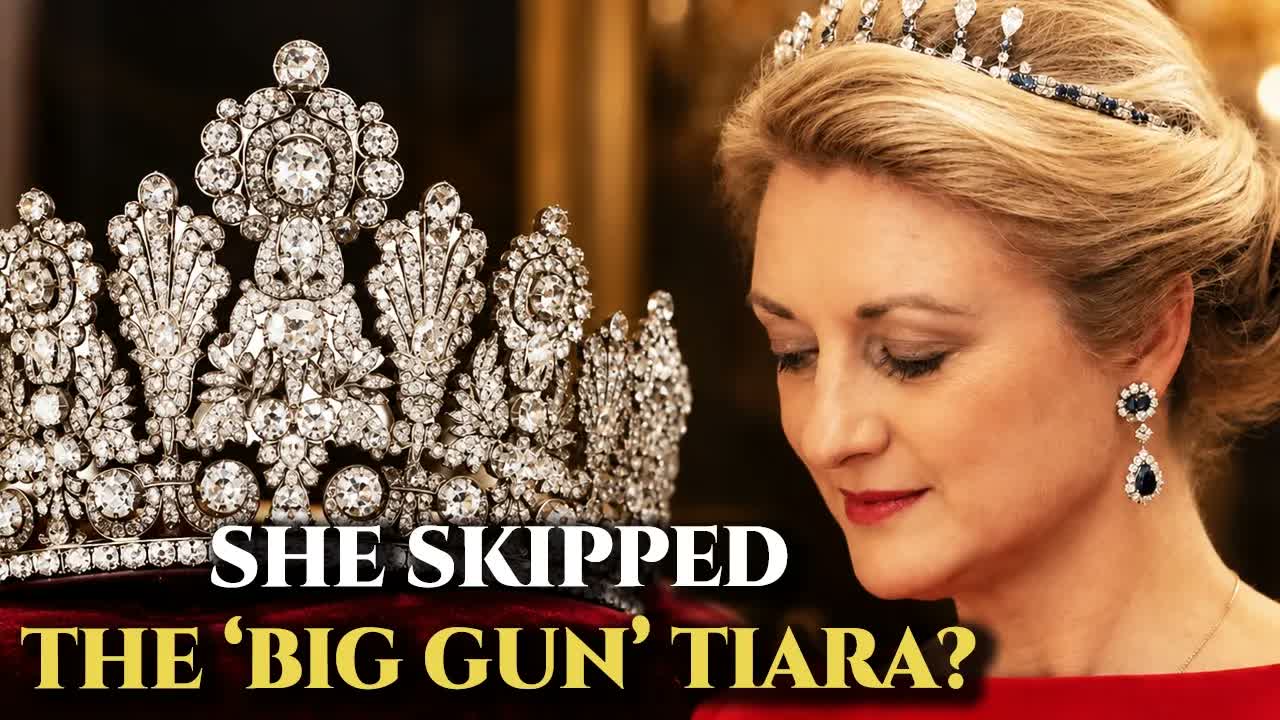
The importance of the visit was clear from the outset. This was the first state visit by a French president to Spain since Nicolas Sarkozy travelled to Madrid in April 2009, a gap of nearly seventeen years. The Spanish royal household described the 2026 visit as an opportunity to strengthen bilateral relations between the two countries, and the official programme reflected that ambition. It included a formal reception at the Royal Palace, a lunch at the Zarzuela Palace, a working meeting between King Felipe VI and President Macron, and, that evening, the traditional gala dinner at the Royal Palace. For jewellery enthusiasts, that dinner was the moment everything had been building toward. A French state visit seemed to offer a particularly tempting stage for a grand statement, and the “Flor de Lis” tiara, perhaps the most famous jewel in the Spanish royal collection, looked like the obvious candidate. There was an additional reason it seemed so fitting: the Bourbon dynasty itself originated in France, so from a purely historical perspective the fleur-de-lis tiara could have provided a glittering link between the Spanish royal family and their French guests. The historic pearl and diamond tiara of Queen Maria Cristina was another possibility. Letizia chose neither.
At the dinner, the Queen wore a pale blue floor-length gown by Carolina Herrera with flowing, cape-like sleeves and floral detailing. The silhouette was light, almost airy, while the diamonds supplied the formal, regal element expected at a state banquet. Above it all sat the Floral Tiara, coordinated with large diamond chaton earrings. She wore her personal rings and dispensed with bracelets. It was not the first time Letizia had worn the Floral Tiara; quite the opposite. The piece has become one of her most frequently used tiaras, and its relatively modest scale and familiar design make it highly practical for her. Yet there is a remarkable story behind the piece, because it was not always a tiara at all. It began life as a floral ornament. The most widely accepted account dates its creation to 1879, when King Alfonso XII asked the British jeweller J. P. Collins to design it for his fiancée, Archduchess Maria Christina of Austria, who later became Queen Maria Christina. Its design is distinctly naturalistic. Rather than strict geometric lines or enormous central stones, it consists of diamond flowers connected by curved leaves and smaller botanical motifs. The central floral element can also be detached and worn as a brooch.
What is stranger still about the jewel is its convertibility. Its elements can be separated, and it has been described as suitable for wearing as brooches or as a necklace. This is where its story takes an unexpected turn. After the death of Queen Maria Christina, the jewel left the direct royal collection and was acquired by the jewellery firm Aldao. What no one anticipated was that Francisco Franco would buy the piece and present it to Princess Sophia of Greece on the occasion of her marriage to the future King Juan Carlos I of Spain. So when the bride received this gift, she was not simply receiving a diamond ornament. She was receiving a jewel that had already lived another life. According to accounts of Sophia’s early use of it, she wore the floral piece as a necklace, while its individual floral elements could also be used as brooches. Only later did she begin wearing the piece in its entirety in the familiar tiara form. The necklace configuration has not been seen in public since, which suggests it is no longer convertible, a detail that remains genuinely curious, since jewellery is usually designed and then redesigned to become more wearable, not more rigid. Of course, the next generation followed. Letizia began wearing the jewel after her marriage in 2004 to the then Prince Felipe, and over the following years it became one of the most distinctive pieces in her rotating tiara wardrobe. There is, however, an important distinction to make. The Floral Tiara is sometimes discussed alongside the most important Spanish royal jewels, but it does not belong to the “Joyas de Pasar” collection in the literal sense. Queen Victoria Eugenia established the tradition of designating certain jewels to pass secretly from head to head within the Spanish royal family, specifically for the use of successive queens. Her will included pieces such as the fleur-de-lis tiara and other important jewels. This tiara has a different status. It became part of Queen Sophia’s personal jewellery collection through her 1962 wedding, rather than being one of the jewels that Ena designated in her will for successive queens.
What is appealing about the choice is that, rather than using a tiara that loudly proclaims Bourbon history, Letizia focused on floral craftsmanship and versatility that suited her gown. While Letizia wore diamonds and a tiara, Brigitte Macron took an entirely different approach. For the formal dinner, the French First Lady wore a long white Louis Vuitton gown embellished with silver detailing. The central section of the dress was relatively simple, while the silver decorations covered the sleeves and sides, giving the look a shimmering effect. She completed the outfit with a metallic clutch and matching shoes. The combination of white and silver created a visual language entirely different from Letizia’s pale blue and diamonds. There was no tiara, of course. The French presidency is a republic, not a monarchy, but the formal dress code gave the evening an unmistakably celebratory character. She did wear beautiful diamond earrings and her large diamond ring, which was entirely appropriate. Brigitte Macron, notably, tends to wear white to almost every state dinner she attends and avoids dark colours. The only pieces from the “Joyas de Pasar” at the dinner were the diamond chaton earrings. They belonged to Queen Victoria Eugenia, who brought a wide range of diamonds into the Spanish royal family through her marriage to Alfonso XIII. The chaton style, consisting of single round diamonds set prominently, became one of the signature elements of Ena’s jewellery collection. Letizia has worn these earrings frequently in recent years, often alongside other “Joyas de Pasar” pieces. They were seen earlier in 2026 when she wore them with Queen Ena’s diamond necklace. So although the tiara itself is not among Ena’s designated inheritance jewels, the earrings accompanying it were. This creates a lively combination: a personal royal tiara paired with jewels belonging to the tradition of successive Spanish queens.
A final comparison makes this year’s banquet even more interesting. The previous French state visit took place in April 2009, when Nicolas Sarkozy and Carla Bruni visited Spain. At that time, Queen Sophia was still reigning queen and wore her magnificent ruby and diamond suite by Niarchos, including a ruby tiara, necklace, earrings and matching ring. These jewels had been given to Sophia by the Greek shipping magnate Stavros Niarchos on the occasion of her wedding, joining her personal collection. Letizia, then Princess of Asturias, wore the Prussian Tiara at the state dinner. Queen Sophia had inherited this tiara from her mother, Queen Frederica of Greece, and it was originally a wedding gift from Kaiser Wilhelm II to his daughter, Princess Victoria Louise of Prussia. This makes the contrast with 2026 particularly striking. In 2009, Letizia was a young princess wearing the Prussian Tiara. In September of this year, she appeared as queen wearing the Floral Tiara. Beside her, the Spanish royal collection had passed into other hands. Generations had changed, and the same palace once again welcomed a French president at a formal banquet. The only disappointment for jewellery and royal watchers was the absence, once again, of Princess Leonor and Infanta Sofia. They have yet to appear with their first tiaras, leaving open the question of which jewels they might choose for their first formal banquet. They did not attend the French state dinner because of their academic commitments. Infanta Sofia was the major absentee from the family, having recently returned to Paris to begin her second year at university. Princess Leonor was also absent because she has just begun her university studies at Carlos III University in Madrid. Despite their absence from the table, French President Emmanuel Macron paid them particular tribute during his official toast. He raised his glass to the future of the Spanish crown, and mentioned the challenge that lies ahead for the next generation.