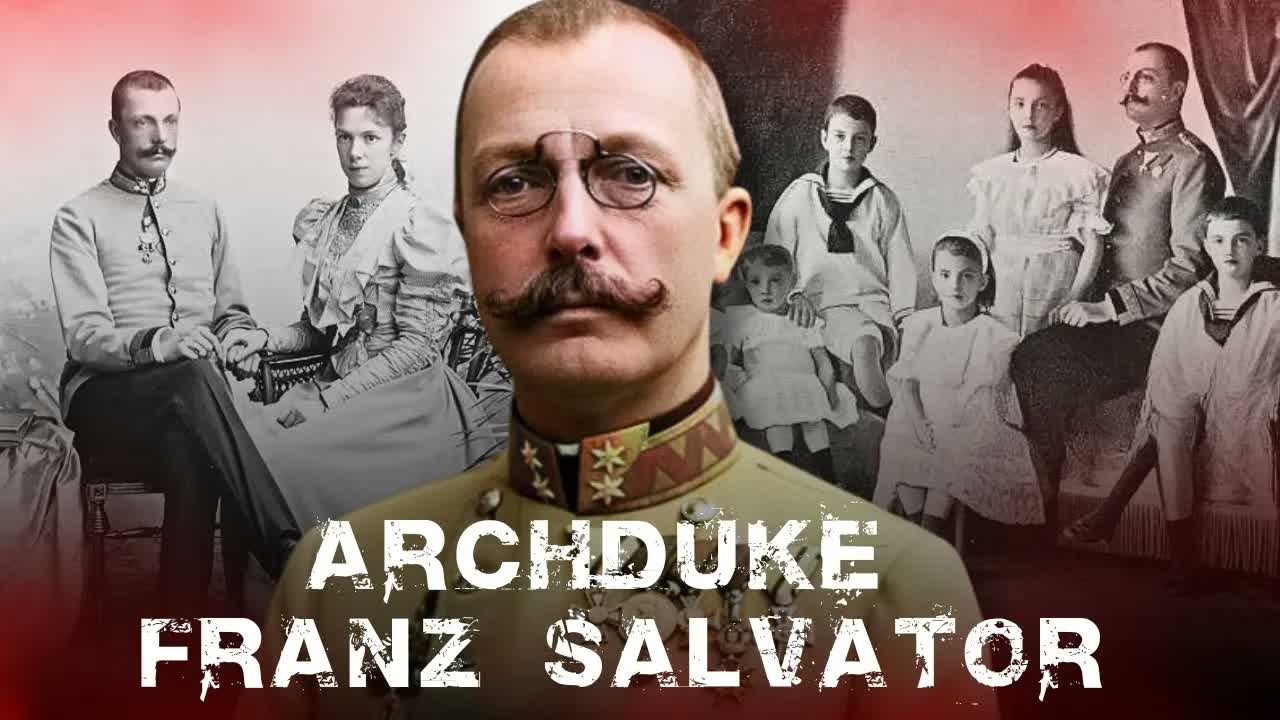
Archduke Albrecht of Austria was the victor of Kustoza, the last great general of a dying empire, and the only man with the genius to save the Habsburg dynasty from itself. He was celebrated as a hero, a savior, and the heir to a legendary military legacy. And for this, he was rewarded with suspicion, relegated to the shadows, and politically crushed by the one man he was bound to serve. How could the man who held the empire’s salvation in his hands be treated as its greatest threat? How did his loyalty become a liability and his genius a crime?

Albrecht was Habsburg royalty through and through, born in 1817 as the grandson of Emperor Leopold II. But his true inheritance, the one that would define his life and seal his fate, came from his father, the legendary Archduke Charles. Charles was more than just a prince. He was a living icon, the victor of Aspern, the only general to have decisively defeated Napoleon himself in a major pitched battle. To be the son of such a man was to be born with an impossibly heavy mantle. From his earliest days, Albrecht was not just another archduke destined for ceremonial duties. He was the heir to a sacred military legacy, a born leader groomed for the battlefield. The central tragedy of his life, therefore, was not a lack of opportunity or a deficiency of talent. He possessed both in abundance. His tragedy was that this unparalleled tactical brilliance, this genetic inheritance of command, collided head-on with the cold, unyielding wall of imperial suspicion. His entire existence would be defined by this agonizing conflict: a life of immense unfulfilled potential, a career of suppressed ambition, all lived out under the long, suffocating shadow of his cousin, Emperor Franz Joseph. The mechanism of his downfall was a poison unique to royal families, a toxic blend of feigned loyalty and corrosive, deep-seated envy. It was not a single dramatic betrayal, but a slow, creeping marginalization. Albrecht’s early successes, his undeniable competence, his natural charisma with the troops—these were not celebrated as assets to the crown. Instead, they were viewed through the warped lens of a young, insecure emperor. Franz Joseph, who ascended the throne in the chaotic fires of 1848 at the tender age of eighteen, saw in his capable cousin not a pillar of support but a potential rival, a man whose popularity and influence could one day eclipse his own. A would-be ally was reframed as a threat, and a life of being perpetually sidelined began. That tragic conflict was inevitable. Albrecht was crushed between two worlds that could never be reconciled: the world of modern, meritocratic warfare he embodied, and the stagnant, paranoid dynasty he was born to serve.

The Habsburg Empire that Albrecht was born into was not a confident, thriving modern power. It was an oppressive, restrictive, and deeply fragile entity, a gilded cage rattling from the aftershocks of the French Revolution and the Napoleonic Wars. This was an empire built on the principle of not changing, an empire defined by its paralyzing fear of the future. Albrecht grew up under the rigid absolutism of his uncle, Emperor Francis I, and later the almost farcically incompetent Ferdinand I. This was an era dominated by bureaucratic stagnation, a suffocating conservatism where reform was considered a dirty word synonymous with treason. The court in Vienna was a collection of aging aristocrats and time-serving functionaries who prioritized the dusty, arcane traditions of Spanish court protocol over military innovation, economic development, or political reality. The dominant force for decades was Prince Clemens von Metternich, the empire’s chancellor, whose entire political system was a reactionary crusade against the nineteenth century itself. Metternich’s Europe was a house of cards, and he spent his life trying to forbid any breeze. He used a vast network of secret police and draconian censors to stamp out any spark of dissent, any call for constitutional government, any flicker of ethnic identity among the empire’s myriad peoples. It was an empire holding its breath, desperately trying to pretend the world was not moving on. But the world was moving on, and the threats were closing in from all sides, pressing against the empire’s brittle borders. Externally, the genie of nationalism, violently uncorked by Napoleon, could not be put back in the bottle. In Italy, which Austria dominated, figures like Giuseppe Mazzini and Giuseppe Garibaldi were fanning the flames of the Risorgimento, the dream of a unified Italian state free from the Austrian boot. To the north, Prussia, with its disciplined army, burgeoning industry, and ruthless political will, was methodically working to supplant Austria as the dominant power among the German states. The revolutionary uprisings that swept Europe in the springtime of peoples in 1848 were a terrifying confirmation of all the court’s worst fears, setting Vienna itself ablaze and forcing the royal family to flee. But the external threats were matched, if not surpassed, by the internal ones. The Habsburg Empire was not a nation. It was a multinational prison of peoples. Hungarians, Czechs, Poles, Croats, Slovaks, Romanians, Serbs, and Slovenes were all bound together not by a shared identity, but only by their shared and often reluctant allegiance to a distant emperor in Vienna. This ethnic tinderbox was simmering, ready to explode at the slightest provocation. Compounding this, the empire’s economy was backwards, its finances a disorganized mess, and its military, which had once faced down Napoleon, was now dangerously outdated, relying on tactics and equipment from a bygone era. The loss of territories and prestige in the decades after Napoleon was not just a political setback; it was a symptom of a deep systemic rot.

The chaos of 1848 exposed the utter bankruptcy of this old system. Emperor Ferdinand I, feeble-minded and incapable of coherent thought, was a hopeless figurehead. His abdication in favor of his eighteen-year-old nephew, Franz Joseph, was a desperate last-ditch gamble to save the dynasty. The empire was literally on fire, and it screamed for dynamic, competent leadership. And there, waiting in the wings, was Archduke Albrecht. He was everything the old guard was not. Trained in the military arts from the age of thirteen, he was a serious student of modern warfare, a man who understood logistics, strategy, and the morale of the common soldier. He was the new blood, the living embodiment of his father’s heroic legacy, the one man who could potentially drag the antiquated Habsburg army into the nineteenth century and forge it into a force capable of holding the fragmenting empire together. He was, in short, the answer. But in a system built on paranoia, the answer looked suspiciously like a problem. The Habsburgs had a long, dark history of internal family rivalries, of brothers betraying brothers and cousins plotting against cousins. The idea of a talented, popular, and ambitious archduke commanding the personal loyalties of a newly reformed army was, to the new, untested emperor and his advisers, a nightmare scenario. They desperately needed Albrecht’s talent to survive the immediate crisis, but they feared that very talent would be their undoing in the long run. And so, from the very beginning of Franz Joseph’s reign, Albrecht was kept in check, his potential a closely guarded and deeply feared commodity, setting the stage for a lifetime of tragic conflict.

In stark, almost defiant contrast to this world of stagnant tradition and reactionary fear, Archduke Albrecht emerged as a force of unsettling modernity. He was the absolute antithesis of the old guard, a man forged not in the perfumed salons of the Hofburg Palace, but in the harsh, unforgiving crucibles of military theory and, eventually, the battlefield itself. While the courtiers and politicians of Vienna were defined by their ceremonial roles and their indecisiveness masked by layers of bureaucratic protocol, Albrecht was a man of cold, hard pragmatism. He understood that the Habsburg army, for all its glorious history, was a museum piece. Its tactics were those of the Napoleonic era, its logistics a shambles, and its officer corps riddled with aristocratic incompetence. He studied the campaigns of Napoleon with a scholar’s intensity, not to imitate the emperor, but to understand the principles of speed, concentration of force, and the effective use of artillery that had revolutionized warfare. He was among the first in the Austrian high command to grasp the transformative potential of the railway for mobilizing armies and the telegraph for coordinating their movements. This was not merely a technical interest; it was a philosophical divide. Albrecht believed that the army existed to fight and win, and that everything else—court etiquette, aristocratic privilege, and the delicate sensibilities of the imperial family—was secondary to that paramount goal. This meritocratic, results-oriented worldview was anathema to a court that valued seniority, lineage, and, above all, political reliability over competence. To Franz Joseph and his circle, an officer’s loyalty was measured not by his victories, but by his deference to the throne. Albrecht, by contrast, was loyal to the empire as an institution and to the army as a fighting force, a loyalty that often put him at odds with the person of the emperor himself.
His moment came in 1866, during the Austro-Prussian War. The conflict was a disaster for Austria. The Habsburg army, hampered by outdated tactics and indecisive leadership, was crushed by the Prussians at Königgrätz. Yet, in the midst of this national humiliation, Albrecht achieved a stunning, decisive victory. On June 24, 1866, at the Battle of Custozza, he commanded the Austrian forces in Italy against the numerically superior army of the Kingdom of Italy. Through a masterful combination of defensive positioning, rapid maneuver, and a devastating counterattack, he annihilated the Italian army, inflicting over 8,000 casualties and capturing thousands more. It was a textbook victory, a brilliant demonstration of his tactical genius. The news of Custozza was a beacon of light in an otherwise catastrophic war. Albrecht was hailed as a hero across the empire. His popularity soared. He was the savior of the Habsburg army’s honor, the living proof that Austrian arms could still triumph. For a brief moment, it seemed as though his talent and loyalty would finally be recognized and rewarded. He was the man of the hour, the only general who had emerged from the war with his reputation not only intact but enhanced. The court, which had so long feared him, now had to celebrate him. But the celebration was hollow, and the reward was a poisoned chalice.

The very victory that should have secured Albrecht’s place at the pinnacle of the military establishment only deepened the emperor’s suspicion. The victory at Custozza, while glorious, was inconvenient. It had been won on a secondary front, in Italy, while the main army was being humiliated in Bohemia. It highlighted, by contrast, the incompetence of the commanders Franz Joseph had favored. More dangerously, it made Albrecht a national hero, a figure of such immense prestige that he could no longer be ignored. To a paranoid court, a victorious general was more dangerous than a defeated one. A defeated general could be dismissed and forgotten. A victorious one commanded the loyalty of the army and the adoration of the people. Franz Joseph, insecure and deeply distrustful of any potential rival, could not tolerate such a figure. Albrecht was not given supreme command of the army. He was not made a field marshal, a rank he had clearly earned. Instead, he was appointed to a series of high-profile but ultimately powerless positions. He was made Inspector General of the Army, a role that gave him the title but not the authority to implement the sweeping reforms he knew were necessary. He was honored with titles and decorations, but his advice was consistently ignored, and his strategic vision for the empire was sidelined. He was, in effect, promoted to irrelevance. The emperor’s distrust, a quiet but relentless force, had done its work. It had neutralized the one man who could have saved the Habsburg army from the slow decay that would ultimately consume it. Albrecht lived out the rest of his long life in this gilded exile. He remained a respected figure, a living monument to a bygone era, but his true potential was never realized. He was the last great general of a dying empire, a man whose genius was both his greatest asset and his ultimate undoing, a victim of the very dynasty he had dedicated his life to serving. His story is not one of failure, but of a brilliance that was deliberately, and tragically, suppressed. It is a testament to the paralyzing power of distrust and the terrible cost of a system that valued loyalty to a person over loyalty to a nation.